
Chicago Corporate Magician and Mentalist
Live mind reading for a city that has always judged the work before the reputation.
Check availability for your Chicago date → Send the date, the venue and the headcount, and you get a straight answer on format and availability.
Gentry is a corporate mentalist for hire in Chicago — Loop and Michigan Avenue hotel ballrooms, association annual meetings and citywides around McCormick Place, client evenings in River North and Fulton Market, and private celebrations on the Gold Coast and along the North Shore.
A mentalist interprets behavior to predict decisions.
Nicholas Gentry is based in Philadelphia and travels to Chicago on engagement. Chicago is the country's convention capital and a city with a long, unsentimental sense of what is good and what is merely expensive. It is a market that has seen everything, which makes it one of the better places to bring an act built on an idea rather than on volume.
Most entertainers ask a room to stop thinking. Gentry asks it to think harder.
Hiring a corporate magician in Chicago
Chicago is a convention city with a professional-services spine, and planners here hire a corporate magician for two very different reasons: to fill a trade-show booth, or to give a firm's clients and partners an evening worth remembering. Gentry is a magician whose mentalism suits both, because his magic depends on the audience's own minds rather than on props.
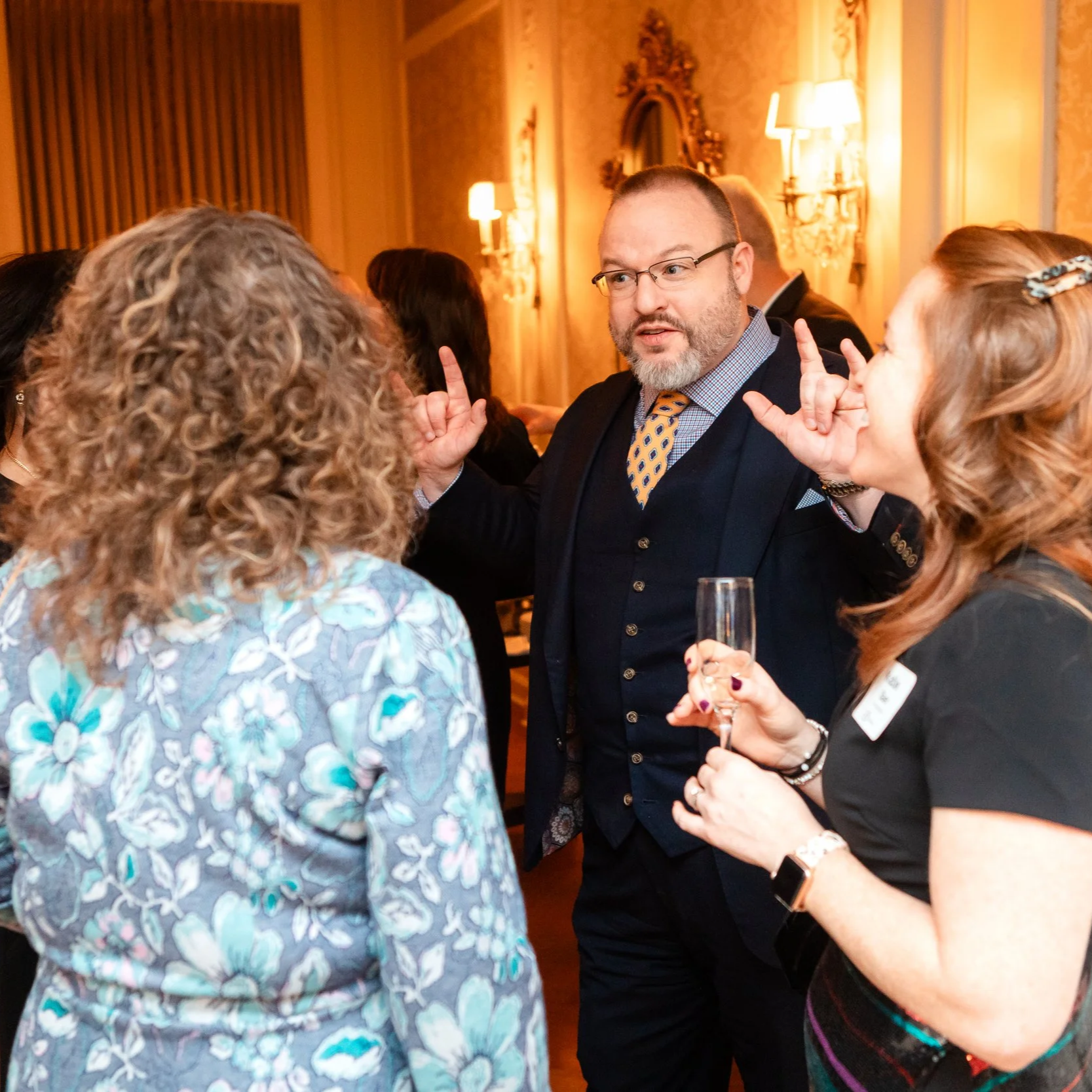
For a law firm, an accounting practice or a consultancy, the strongest format is usually close-up. Gentry moves through a client reception or a partners' dinner with mind reading for a few guests at a time, which gives people who already know each other a new reason to talk. When the evening has a program, he adds a stand-up show of 45 to 60 minutes. He trained in rhetoric at Carnegie Mellon and taught at four universities, and an audience of lawyers, analysts and executives will hear it in how he handles a room.
For exhibitors at a Chicago convention, the brief is different and so is the work. Gentry works the aisles, not just the booth, stopping attendees well beyond your stand and walking interested ones back to your sales team. That is how he has worked Business Hall booth #2561 for LayerX at Black Hat in Las Vegas, and booth #1591 at Caesars Forum for Port.io. Michael Yoder of Funny Business wrote that he was "actively generating hot leads for my clients at a Gartner conference as well as at re:Invent."
Associations hiring a magician for an annual meeting can combine formats: a keynote that uses live mentalism to show how people judge and decide, followed by a reception set the same night. One corporate magician can cover the floor, the stage and the cocktail hour, at one all-inclusive fee.
Hire a corporate mentalist in Chicago
Chicago books more corporate entertainment than almost any city in America, and it books it with a purchasing department.
This is the convention capital of the country. Between McCormick Place, the Loop's convention hotels and a meetings economy that fills the calendar from March through June and again from September through November, Chicago planners run more events per year than their counterparts almost anywhere, and they have seen more entertainment than their counterparts almost anywhere. The upside is that a Chicago planner recognises the difference between a program that works and a program that fills a slot immediately, and does not need to be persuaded that the difference matters.
What the calendar is made of: association annual meetings and their opening receptions, citywide conventions and the client events that orbit them, sales kickoffs in January, user conferences, partner and channel dinners, law firm and consulting client evenings, holiday parties at a scale few cities match, and the awards nights of an economy that still makes, moves and insures physical things.
What corporate entertainment in Chicago has to do
The association and convention economy sets the terms. Chicago is home to an unusual concentration of national trade and professional associations, and it hosts the annual meetings of hundreds more. Those events have a shape: a general session, an exhibit floor, an awards luncheon, an opening reception, and a closing night that has to leave several thousand people with something to say to each other on the way out. Entertainment in that structure is not decoration — it is the part of the program that has to carry the room between the substantive parts.
The trading, legal and consulting floors want something they cannot immediately solve. Derivatives, asset management, insurance, a very large legal market and the consulting firms that serve them make up a professional class whose working day is pattern recognition under time pressure. That audience will not be impressed by being fooled and will be genuinely interested in being outthought. Material built as argument, performed for people who build arguments for a living, is close to an ideal match.
The hotel ballrooms are the default and they are excellent. Michigan Avenue, Streeterville, the Loop and the Gold Coast hold a density of grand ballrooms that few cities can equal, most of them with proper house sound, proper lighting and banquet staff who have done this a thousand times. A stand-up show drops into those rooms with a handheld microphone and a small table; walk-around drops in with nothing at all.
River North, Fulton Market and the West Loop carry the less formal half of the calendar. Restaurant buyouts, loft and studio spaces, rooftop venues, converted industrial rooms and design-forward private dining have taken over the client-entertaining end of the Chicago market. Those rooms are often beautiful and almost never built for performance: hard surfaces, no stage, no permanent sound, columns, and a floor plan that keeps guests moving. Close-up mentalism is the format those rooms were made for — it needs a few feet of floor and a few people, it works at conversational volume, and it requires no load-in.
The museum and landmark circuit is a real Chicago advantage. A city of this size with this architecture rents out rooms that make an evening feel like Chicago rather than like a ballroom anywhere: museums, historic halls, a planetarium on the lake, nineteenth-century interiors downtown. Planners use them for exactly that reason, and then discover that most programming fights the room. Close-range work lets the venue keep being the venue.
Manufacturing, logistics and food entertain differently, and well. Chicago is still a rail, freight, food and industrial city, and those award nights, distributor meetings, customer appreciation evenings and safety milestone celebrations are some of the best rooms in the business — mixed, direct, unpretentious, and immediately responsive to something performed a few feet away rather than announced from a stage.
The North Shore and the suburban corridors carry the private-event market. Milestone birthdays, anniversaries and engagement parties in Evanston, Wilmette, Winnetka, Lake Forest, Hinsdale, Oak Park and Naperville. Twenty to eighty guests, a beautiful room, no stage, and a host who wants the evening to feel effortless and to be talked about afterwards.
Logistics are simple and worth saying. Walk-around requires no stage, no sound, no power and no setup window. Stand-up requires a handheld microphone and light on the performance area. A landmark venue with a difficult load-in, a museum with rules about what may be brought inside, and a convention hotel ballroom on a tight turn all get the same evening on the same terms.
Why Chicago event planners hire Gentry
Gentry holds an MA in Rhetoric from Carnegie Mellon University and a BA in Philosophy. Rhetoric is the formal, two-thousand-year-old discipline of how people are persuaded — the study of argument, audience and proof. In a city whose professional class argues, negotiates and prices risk for a living, a performer whose material is constructed the way an argument is constructed is speaking the local language.
He has taught at Carnegie Mellon, Temple University, Duquesne University and the University of Pittsburgh. Teaching is the discipline of holding a room that did not choose to be there — which is the exact condition of the entertainment slot after the awards presentation on night two. His TEDx talk is Faking It IS Making It. Peace Corps, Ghana. JET Programme, Japan. Working jazz bassist, which is where the improvisation comes from: reading a room live and holding the structure while he does it.
He is a mentalist, and he says so plainly. The work is performance — built on rhetoric, close observation and a career spent reading rooms — and in front of an audience that evaluates claims for a living, that plainness is exactly what earns their attention.
The governing principle: the audience are collaborators. The people who volunteer come out of the experience looking sharp in front of the colleagues and clients whose good opinion they care about, and the planner who booked it gets the credit for that all evening. Blow Their Minds (Without Insulting Their Intelligence).
Chicago venues and events this work is built for
Michigan Avenue, Streeterville and Gold Coast hotel ballrooms — including grand traditional rooms such as the Gold Coast Room at The Drake, suited to a stand-up show used as the evening centerpiece after dinner.
Loop and River North convention hotels — citywides, association annual meetings and the receptions that surround them.
McCormick Place — general sessions, exhibit-floor booth activation and the off-site evenings that come with a citywide.
Executive and leadership meetings in rooms built for them — the Devonshire Ballroom at The Langham and its equivalents, where the program is strategy and the entertainment has to respect that.
Design-forward private rooms — the Ivy Room at Tree Studios and similar courtyard and studio spaces, for intimate client evenings.
River North, Fulton Market and West Loop restaurant buyouts, lofts and rooftops.
Museum, planetarium and landmark venue evenings — the kind of room that has objects in it and no stage.
Law firm, consulting, insurance and asset management client events and partner dinners.
Sales kickoffs, user conferences, and partner and channel dinners.
Manufacturing, rail, freight, logistics and food-industry award nights and customer appreciation evenings.
Company holiday parties and employee recognition nights across the city and the collar counties.
North Shore and suburban private celebrations — milestone birthdays, anniversaries and engagement parties in Evanston, Winnetka, Lake Forest, Hinsdale, Oak Park and Naperville.
Named as rooms this work suits.
Chicago corporate entertainment formats
Walk-around mentalism for a Chicago reception or cocktail hour
Close-up mentalism moving group to group through a reception. Three to six people at a time. The default for an association opening reception, a River North client evening or a Fulton Market buyout where guests arrive and leave on their own schedule — every group gets a complete experience in a few minutes, and the room stays fluid. No stage, no sound, no rehearsal, and nothing that touches your run of show.
Stand-up mentalism show for a Chicago corporate event
A structured 35–50 minute performance for a seated audience. Handheld microphone, a small table, floor level or riser. Plays to rooms as small as five and as large as several thousand. The after-dinner slot at an awards evening, an annual meeting banquet, a sales kickoff or a holiday party.
Walk-around plus stand-up: the full evening
Walk-around through the cocktail hour, stand-up after the program. The standard booking for a Chicago gala or awards night, and the most delivered in one night — it warms the room before the program and gives the guests something to talk to each other about on the way out.
Museum and landmark-venue mentalism
Close-range work built for rooms with objects, columns, marble and no stage. It needs a few feet of floor and a few people, works at conversational volume, and lets an architecturally significant room stay the star of the evening rather than becoming a staging problem.
Magician for private events in Chicago
Close-up mentalism for milestone birthdays, anniversaries and engagement celebrations in the Gold Coast, Lincoln Park, Evanston, Winnetka and the western suburbs. Twenty to eighty guests, no equipment, no setup, and an evening the host does not have to run.
Trade show booth entertainment at McCormick Place
Roving close-up on the exhibit floor, engaging attendees in the aisle, qualifying them in conversation, and walking the right ones back to your booth for a warm handoff to a named person on your team. Scheduled against floor hours and run inside show rules. See trade show presentations.
Keynote speaker on persuasion for a Chicago general session
A speaking program on rhetoric, persuasion and how belief gets built, demonstrated live rather than described. Built for association general sessions, leadership meetings, and commercial and development teams. See keynotes.
Testimonials
Alison Reeley, Chief Operating Officer, Nurture Marketing
Jackie Reardon, Head of Marketing, Sygnia Cybersecurity
Donna Thomas, CMP, Director of Events, Crowne Plaza Hotel
Devon Pasha, CMP, CED, Chief Experience Officer, DMP Creative
Joe Mallee, CEO, MassMutual of Eastern PA
Athena Ascione, Senior Events and Marketing Leader, Lightyear Telecom
Maybar Durst, CEO, TeamUp
Edan Tal, Director of Marketing, Port AI
Michael Yoder, Booking Agent, Funny Business Entertainment Agency
Bruce White, Johnson, Kendall & Johnson
Pat Mullen, President of Commercial Insurance, Johnson, Kendall & Johnson
Lindsay Hauenstein, Special Projects Coordinator, United States Cold Storage
Full quotes: testimonials.
FAQ: hiring a mentalist in Chicago
Does Gentry perform in Chicago?
Yes. Gentry is based in Philadelphia and travels to Chicago for corporate and private events — Loop and Michigan Avenue hotels, McCormick Place programming, museum and landmark venues, River North and Fulton Market private rooms, and North Shore and suburban celebrations. A Chicago date is quoted as one complete engagement.
What determines the fee for a Chicago booking?
A Chicago fee is set by the date, the format, the length of coverage and how many programs the event includes — walk-around, stand-up show, keynote, or a combination. Gentry never bills separately for travel or accommodation — fees are all-inclusive. Every proposal comes back itemized.
How far in advance should we book a Chicago date?
Book as soon as the date and the venue are set. Chicago's meetings calendar concentrates into the same weeks each spring and autumn, December fills first, and the strongest landmark and museum venues in this city are spoken for months ahead — an early hold means the run of show gets built around the performance.
Is this a good fit for an association annual meeting or citywide?
Yes, and it is one of the best fits in this city. Walk-around covers an opening reception without touching the schedule; the stand-up show fills the after-dinner slot at an awards banquet; and the keynote works as a general session when the theme is persuasion, judgment or decision-making. All three can run on the same trip.
Can he work a museum, landmark or loft venue with no stage?
Yes — those rooms are among the best uses of the format. Close-range mentalism needs a few feet of floor and a few people, works at conversational volume, and requires no load-in, so a room with columns, marble, objects and rules about what may be brought inside is an easy booking rather than a hard one.
How does this play for a room of traders, lawyers and consultants?
It plays to the top of the room, which is why this city suits him. The material is built as argument and the audience is treated as fully competent, and the people who step forward come out of it looking sharp in front of the colleagues and clients whose good opinion they care about.
What does he need from the venue?
For a stand-up show: a handheld microphone through house sound, a small cocktail table, and light on the performance area. For walk-around: he arrives and starts. A full technical rider ships with every contract, and setup access before doors is all that is asked for.
How large can the audience be?
The stand-up show plays to rooms as small as five and as large as several thousand. Walk-around works group by group, so it fits any headcount — a 30-person partner dinner in the Gold Coast or a 1,500-person opening reception at a convention hotel.
Can he perform at a private party in Lincoln Park, Evanston or Winnetka?
Yes. Private celebrations of twenty to eighty guests are a natural fit for close-up work: no equipment, no setup, no rearranging of a room the host has already made beautiful, and guests who spend the rest of the night comparing notes with each other.
How do we book a Chicago date?
Send the date, the venue, the headcount and what the evening is supposed to accomplish, and you get a format recommendation and a quote back. Start at contact.
How much does it cost to hire a corporate magician in Chicago? Pricing follows the scope. A partners' dinner, a stand-up show for an association meeting, and two days in a convention booth are not the same engagement, and the date and audience size shape the number further. Gentry's fees are all-inclusive; he does not ordinarily bill separately for travel. The fastest route to a firm quote is to send the date, the venue and the format you have in mind.
How is a mentalist different from a magician? Mentalism is a specialized branch of magic. Where a magician might transform an object, a mentalist works with what an audience member is thinking, choosing or remembering, and reveals it. For a Chicago law firm or association, that keeps the experience conversational and adult: it is built on the guests themselves. Gentry is a corporate magician who chose mentalism as his field, and everything he performs comes from it.
Can a magician work our Chicago client reception? Yes. Client receptions are where close-up mind reading shines, because each moment is personal to the two or three guests in front of him and your hosts are right there to share it. He can carry the full reception or a set portion of it, and add a short stand-up show if the evening has a program. Send the date and the guest count, and he will confirm availability.
Book a Chicago date
Send the date, the venue, the headcount, the audience, and what the evening is supposed to accomplish. You will get a straight answer on format and the version of the program that does the most for your event.