An interactive keynote approach to leadership, assumptions, and decision-making.
If you’re choosing a keynote speaker for a leadership conference, executive retreat, or corporate event, ask what your people will become better equipped to do.
I’m Nicholas Gentry. I deliver customized, interactive keynotes using mentalism, magic, and Socratic inquiry to help people examine assumptions, question premature certainty, and remain curious when they don’t understand something.
My shorthand for that assignment: assume you’re always stupid—and thereby become a lot smarter.
I include myself. It would be a suspicious philosophy if the man onstage were the sole exception.
What magic reveals about how we think
A magic trick happens.
One person says, “I have guesses. I have directions I’d investigate. But I have no idea how you did that—and I think that’s fun.”
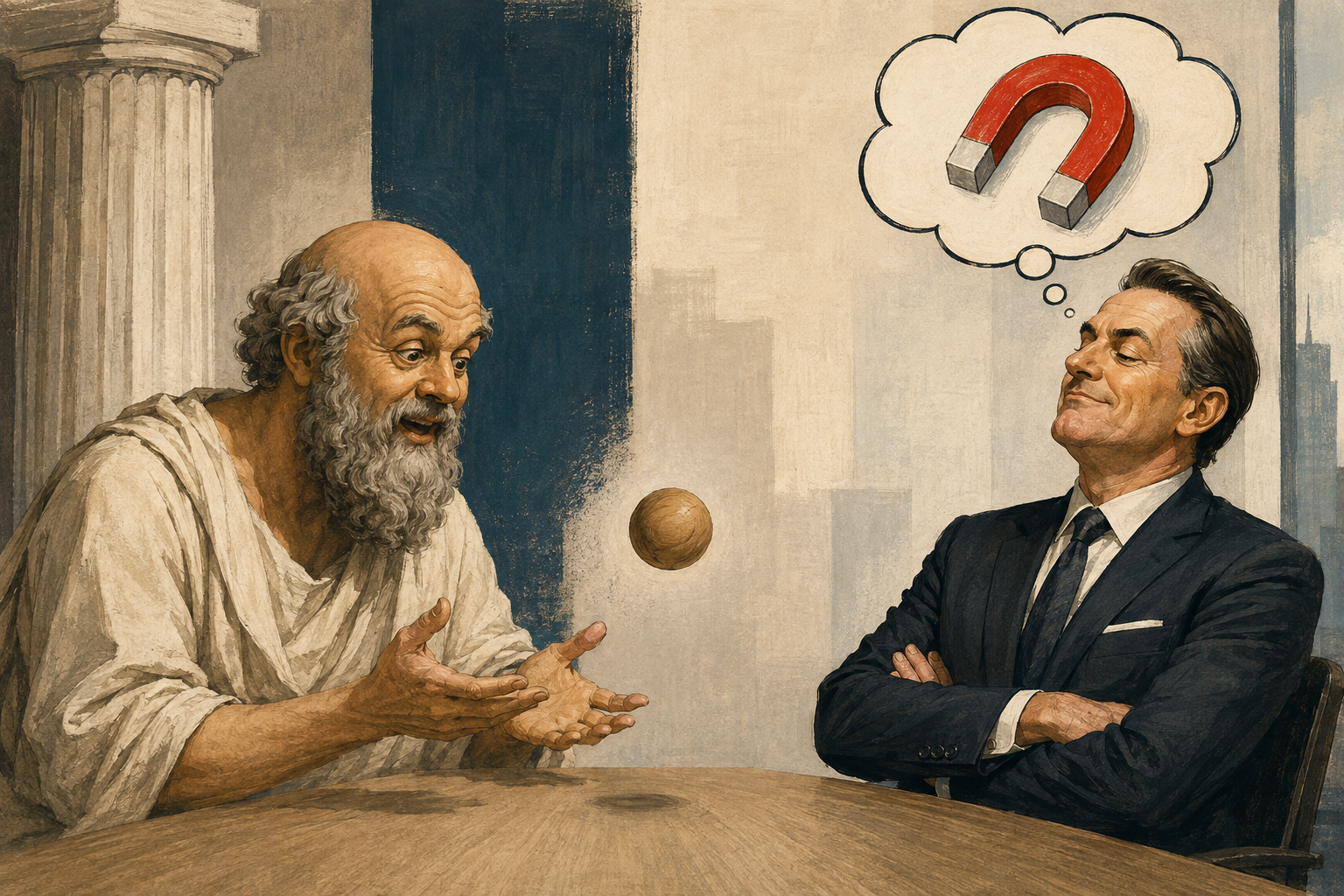
Another says, “Must be magnets.”
There may be no reason to suspect magnets. Magnets have been recruited to close the case.
The first person enjoys the distance between having an idea and knowing an answer. The second would like that distance to disappear.
I have watched this repeatedly. Here is my deliberately exaggerated description: geniuses give 100 percent credit for the 10 percent they don’t understand. Morons take 100 percent of the credit for the 1 percent they do understand.
I am capable of both responses.
And you’ll never guess which person is often in charge.
The one who has already solved it. Magnets.
Why Socratic inquiry belongs in a leadership keynote
Socrates made examining our supposed knowledge a philosophical practice. What do you mean? Why do you believe it? Does your explanation hold up?
These questions expose a gap we sometimes prefer to conceal: we can feel certain without understanding very much.
Your intelligence never exempts you from overlooking something, explaining it badly, or defending an answer because it belongs to you. Keeping that possibility available gives you a chance to become smarter.
This matters in an organization because a leader’s explanation becomes something other people must work under.
“That won’t work. We tried it before.”
Perhaps this is hard-earned knowledge. Ask a few questions.
What did we try? Who was it for? Why did it fail? What has changed?
The answers may confirm the objection. They may reveal that an old experience has been stretched to cover a new situation it does not adequately explain.
Either way, you have more to work with than the authority of the person speaking.
What I want your audience better equipped to do
My keynote work centers on recognizing when a guess has hardened into a conclusion—and reopening the question.
The practice is straightforward:
Separate what you noticed from what you inferred.
Identify the assumptions supporting your explanation.
Ask what evidence would make you reconsider.
Listen to the answer, including when someone else supplies it.
An organization still has to act. The aim is to hold a position firmly enough to act and provisionally enough to revise.
That is a more useful assignment than making everyone briefly invincible. Corporate audiences have endured enough rah-rah feel-goodism to recognize a speaker turning into a 1980s motivational cassette.
They need someone with a skill to impart and a way to impart it.
An interactive keynote needs something to show
Magic and mentalism give my audience a shared experience to examine.
What did you notice? What explanation occurred to you? When did it begin to feel certain? How did you respond when it stopped working?
A trick does not prove that anyone has poor business judgment. It makes our response to uncertainty available for inspection—including the impulse to say “magnets” and move on.
“Show and tell” remains a good description of the assignment. We had this much figured out in elementary school.
The demonstration earns attention. The inquiry gives that attention somewhere useful to go.
The experiences I bring—and why they matter
Every field and biography has potential lessons for an organization: building classical guitars, making pottery in rural China, nearly dying on K2.
The lesson requires examination. If someone nearly died on K2 and concluded “never give up,” I have questions.
Here are some of my materials.
The Peace Corps taught me how to fail. They call it the toughest job you’ll ever love. You have to do it before understanding that the assignment can amount to baking a cake without water or flour.
You can arrive prepared, committed, and enthusiastic.
There is still no flour.
Before prescribing more motivation, examine what you assumed would be available, whether the assignment makes sense, and who understands the circumstances better than you do.
Magic and mentalism taught me that faking it is making it. The convincing appearance takes real skill to construct. Appreciating that accomplishment and understanding how it happened are different things. Can we give credit while leaving the explanation open?
Jazz keeps teaching me to listen. Shared rules let musicians create together, but knowing the tune does not mean I know what happens next. Someone else may contribute something my prepared response no longer fits.
Each experience returns to the same question: can I recognize the limits of what I know while there is still something useful to learn?
Choosing a keynote speaker who understands your goals
The specific show and tell matters. The ability to tie it in matters more.
My experiences become useful to your organization when I understand your circumstances well enough to make the connection. What are your people trying to accomplish? Where are they getting stuck? What would you like them better equipped to do?
That is why my keynote presentations are customized to the audience and event. A leadership conference, executive offsite, and team gathering may need different applications of the same underlying inquiry.
A speaker who assumes they already know what you need is committing the very error I want us to examine.
The speaker does understand your goals, right?
Putting your logo on a slide is insufficient evidence.
When evaluating a leadership speaker, demand something worth learning, a way to demonstrate it, and a thoughtful connection to your priorities. Notice whether their questions show a willingness to discover something.
The Socratic requirement applies to the person onstage first. “Assume you’re always stupid” cannot become a clever way of telling everyone to agree with me.
Someone in your organization is going to say, “I have some ideas, but I don’t know.”
I would like that person to have a future there.
Planning a leadership conference, executive retreat, or corporate event? Explore Gentry’s keynote experiences or discuss your audience, goals, and event.