Fallen Angels or Smart Apes? A Manifesto on Success Without Pandering
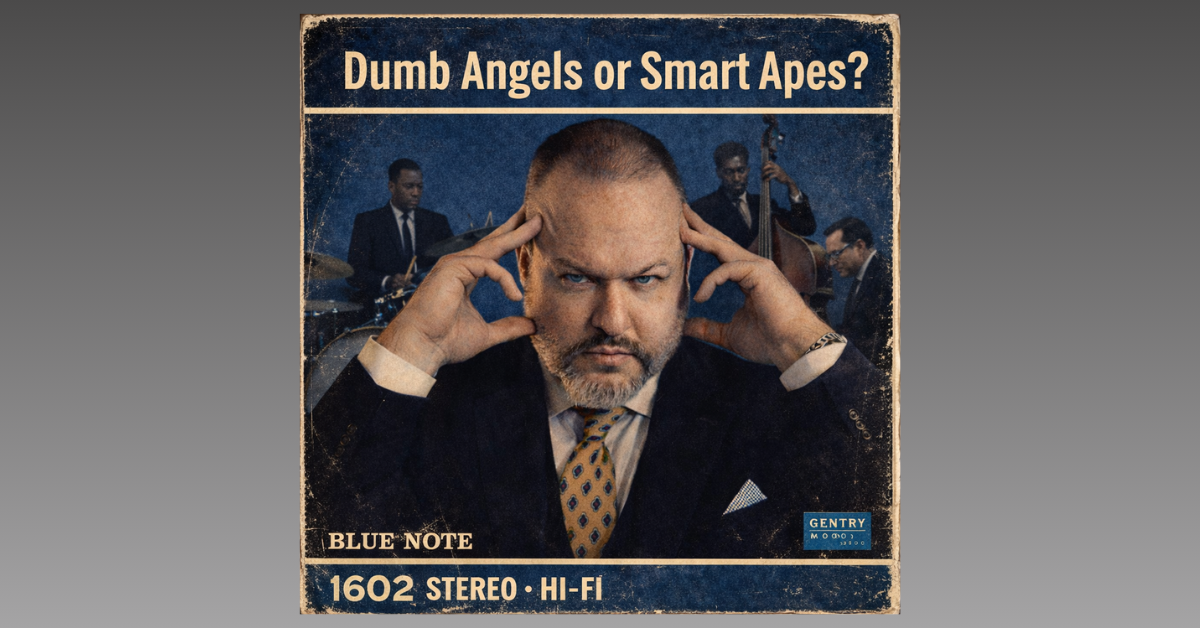
Dumb Angels or Smart Apes?
A Practical Case for Success Without Pandering
Every public act makes a wager about the people in the room — not just about what they want, but about what they are.
Are they best understood as smart apes: stimulus-driven, easily distracted, reward-seeking, responsive only to volume, repetition, and emotional bait? Or as fallen angels: limited, distracted, imperfect, but still capable of attention, judgment, restraint, and growth when addressed seriously?
Most modern public life answers this question silently.
And it answers it badly.
The Audience You Assume Is the Audience You Create
Look at the image. That’s me posed on a Blue Note record cover — no spectacle, no grin, no demand for approval.
I don’t know if I always live up to it, but I know that I want to.
Jazz musicians like Miles Davis, Thelonious Monk, and Herbie Hancock did not ask audiences what they wanted, but they also did not treat them as idiots. They assumed something demanding of the listener, and then made that assumption true.
That’s the hidden lesson: The artist does not merely discover an audience; he elicits one. Treat people like smart apes and they will behave accordingly. Treat them like fallen angels and often, surprisingly, they rise.
Why “Fallen Angels” Beats “Smart Apes”
The smart-ape model dominates modern communication:
simplify or lose them
entertain or be ignored
provoke or disappear
flatter or fail
This model works. It also trains audiences to become exactly what it assumes they are.
The fallen-angel model is harsher and more respectful at the same time.
It says:
you are limited, but not trivial
you are distractible, but not incapable
you can follow complexity if it’s earned
you deserve seriousness, not sedation
This is not optimism; it is a standard.
And it places responsibility on the audience as much as the artist or speaker.
The Jazz Standard: Not For the Audience, but Also Not Against Them
Serious jazz was never made for the audience in the marketing sense, but it was never hostile to them either.
It was made for the music, with the assumption that the listener could meet it more than halfway.
No pandering, no intimidation, no explanatory hand-holding — just a standard, held firmly and without apology. Some listeners followed. Some didn’t. The music didn’t chase them either way. That posture — quiet, demanding, unflinching — is the alternative to both pandering and “losing them.”
The False Binary: Pandering or Coercion
Modern public life offers two corrupt options:
Pander — simplify, outrage, perform relevance
Dominate — manipulate, moralize, intimidate
Both treat people as animals, either to be fed or herded.
Both scale. Both degrade judgment, yours and theirs.
The fallen-angel model rejects this binary. It assumes the audience is capable of more if you don’t insult them first.
Conditioning the Room
Audiences are not fixed entities. They are conditioned environments.
What you reward, you get more of. What you tolerate, you invite. What you assume, you summon.
If you speak as though people cannot follow nuance, they won’t. If you perform as though attention must be bribed, it will be. If you treat seriousness as a liability, it becomes one.
But if you hold a standard, calmly, patiently, without resentment, people often meet it. Not all, not immediately, but enough.
Who This Is For
This approach is for people who:
are tired of being told to “optimize engagement”
distrust hype, outrage, and motivational theater
want to work at full intelligence without apology
are willing to grow slowly in exchange for integrity
It is not for those seeking:
viral certainty
ideological comfort
maximal reach at any cost
That market is already saturated.
A Durable Definition of Success
Success, under the fallen-angel model, looks like:
enough income to remain independent
enough trust to speak plainly
a small but serious audience
work that doesn’t rot with time
Not domination, not mass appeal, but sustainability without self-contempt.
What This Path Refuses
This path refuses to become:
a professional simplifier
an algorithmic hostage
a motivational caricature
a loud person mistaken for a serious one
It accepts misunderstanding, slower growth, and partial opacity.
What it does not accept is degrading the work in advance out of fear that the audience can’t handle it.
An Invitation, Not a Manipulation
This is not a funnel. It’s a wager.
If you treat people as smart apes, you will get… well, frankly, crap. If you treat them as fallen angels, you may get something rarer: attention, respect, and growth.
That is the gamble jazz musicians took. That is the posture behind the image.
Not smart apes chasing stimulus, but fallen angels, capable of more than they’re usually offered, when someone finally expects it of them.