
Corporate Holiday Party Entertainment Ideas for Every Size of Company
The company holiday party is usually planned by one person on behalf of everyone. An HR lead, an office manager or an executive assistant chooses the venue, the menu and the entertainment, and then spends the evening watching to see whether it works. If it lands, nobody thanks you by name. If it misses, everybody knows who booked it.
Here are ten corporate holiday party entertainment ideas, with honest pros and cons, notes on budget and group size, and a word on inclusivity, daytime events and large-group logistics. The final section makes the case for the option Gentry offers: a corporate magician whose specialty is mentalism. Based in Philadelphia, Gentry has performed at company holiday lunches, dinners and receptions in Pennsylvania and New York, and for crowds of 800.
Before you choose: four questions
How many people, and how well do they know each other? Forty colleagues from one office need something different from 400 people across departments who have only met on video calls.
Day or evening? A lunch suits staff with commutes and families. An evening party allows a longer program and a bigger centerpiece.
Who might feel left out? People who do not drink, do not dance, do not celebrate Christmas or simply dislike being the center of attention should all have a good night.
What should people say on Monday? The best parties leave behind one shared story. Decide what you want it to be.
Ten company holiday party ideas, with pros and cons
1. A DJ and dancing
Best for: Evening parties, 75 guests and up, younger teams.
Pros: Fills the room with energy and keeps the night moving.
Cons: Many guests never dance, and loud music ends conversation. Half the room may spend the night on the edges. Moderate budget.
2. A live band
Best for: Larger evening events with a ballroom and a dance floor.
Pros: Feels like an occasion, and a good band reads the crowd.
Cons: One of the larger line items, with space and sound requirements. Like a DJ, it suits the dancers more than the talkers.
3. Games and team competitions
Trivia about the year, a quiz, a holiday-themed challenge, minute-to-win-it rounds.
Best for: Groups of 20 to 150 who know each other.
Pros: Inexpensive, mixes departments and rewards teamwork.
Cons: Quieter staff may dread it, and it needs a confident host. With large groups the rules get lost in the noise.
4. A casino night
Rented tables with professional dealers and play money.
Best for: Evening parties of 50 to several hundred.
Pros: People drift between tables, and nobody has to perform.
Cons: Only the players are engaged, it can feel generic, and the cost scales with the number of tables.
5. An off-site activity
Bowling, escape rooms, axe throwing, a cooking class.
Best for: Teams of 10 to 60.
Pros: Active and different from the usual office party.
Cons: Excludes people with mobility limits or no interest in the activity. Venues cap group size, so large companies have to split up and lose the sense of one event.
6. A photo booth or caricature artist
Best for: Any size, as a side attraction.
Pros: Guests take home a souvenir, and it runs without a schedule.
Cons: It serves one person or group at a time and creates a queue. It works alongside a centerpiece rather than as one.
7. A comedian
Best for: Seated audiences of 50 or more.
Pros: A strong set gives the whole room a shared laugh.
Cons: High risk in mixed company. One joke aimed at the wrong person, or one edgy bit in front of the CEO, becomes the story nobody wanted. Vet carefully.
8. A giving-back activity
Assembling care packages, a toy drive, a matched donation.
Best for: Daytime events and mission-driven teams.
Pros: Meaningful, inclusive and easy to explain to leadership.
Cons: It can feel like more work if it runs too long, and it rarely provides the celebration people were expecting.
9. A holiday lunch instead of a party
A private room at a restaurant during working hours.
Best for: Teams of 15 to 75, hybrid offices, staff with evening commitments.
Pros: Higher attendance, lower bar bill, and nobody misses bedtime.
Cons: A tight window, with people watching the clock. Entertainment has to fit the gaps between courses.
10. A corporate magician and mentalist
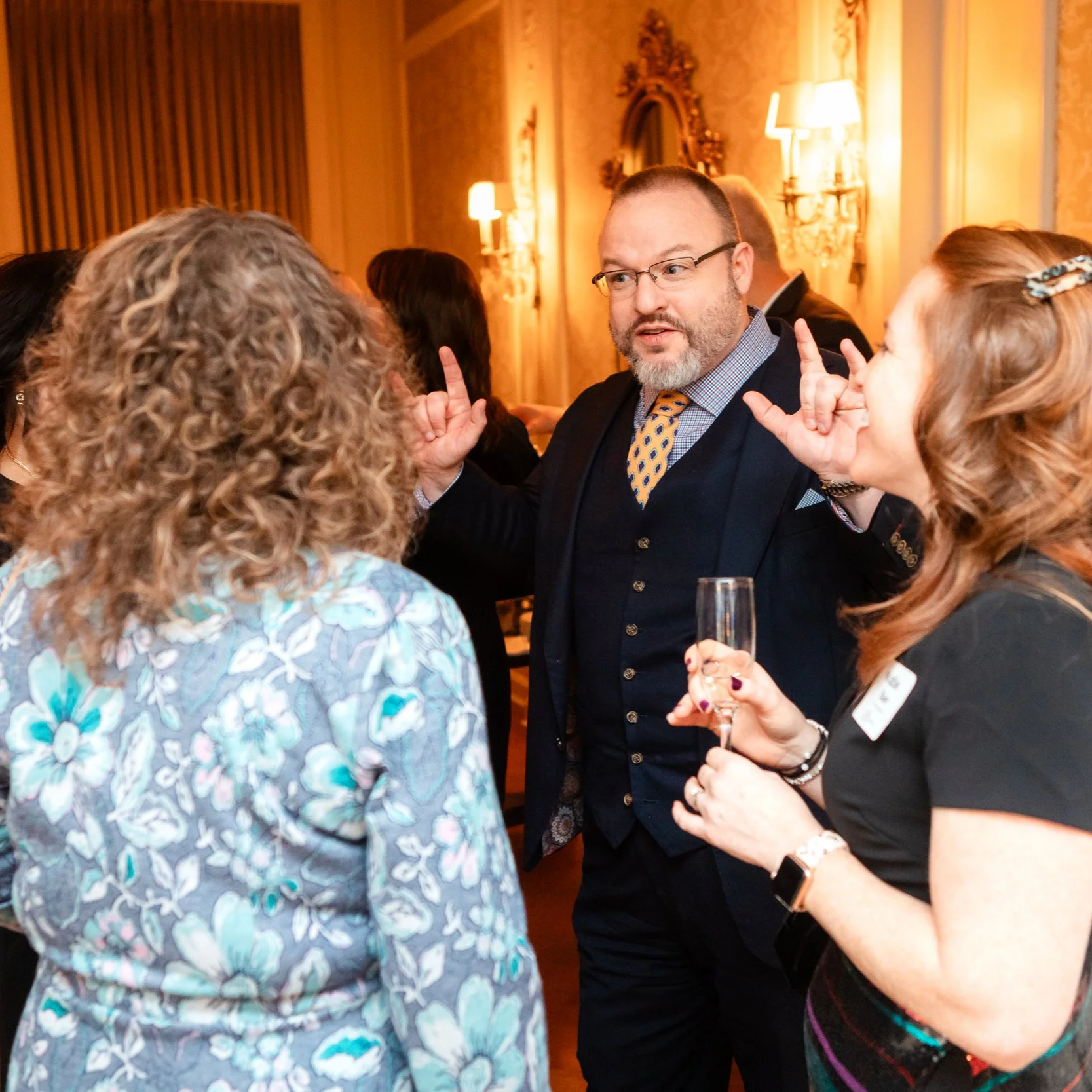
Strolling mind reading during arrival and drinks, then a short stand-up show after the meal.
Best for: Any size, lunch or evening.
Pros: It reaches the people who never dance and never play the games. It gives everyone the same story to tell, and no one has to do anything to enjoy it. It scales from a small private room to a ballroom.
Cons: Performers vary a great deal. Ask what a set looks like for a company audience and which companies have booked it.
The rest of this page explains why we think the last idea works best for most company parties.
Making the party inclusive
A holiday party is often the only time the whole company is in one room, and the entertainment should work for all of it.
Choose activities that do not depend on drinking, dancing or a particular religious tradition. Avoid anything that puts one person on the spot in front of their manager. Make participation a choice. Provide good non-alcoholic options and plenty of food. And check the venue for step-free access before you sign.
Mentalism handles most of this on its own. It is conversational, it works for every background and age group, and guests decide for themselves whether to step in or simply watch.
Daytime versus evening
Daytime. Lunches draw better attendance, especially in hybrid offices and among parents. The entertainment has to be portable and quick: strolling work between courses, or a short set over dessert. Gentry's holiday-season lunch for The Perecman Firm, a New York law firm, followed that pattern, for about 40 guests in a private restaurant room.
Evening. Dinners and receptions allow a cocktail hour, a full meal and a centerpiece. The classic structure is strolling entertainment as people arrive, then a stand-up show once everyone is seated. That is exactly how APX Enclosures ran its company dinner at Orchards Restaurant in Chambersburg, Pennsylvania, on 13 December 2024: strolling first, then the stand-up show.
Holiday party entertainment ideas for large groups
Large groups change the problem. With 300 or more guests, most ideas on the list above begin to break: queues form at the photo booth, games become unmanageable and only the people near the band can hear each other.
What scales is a two-part plan. During the reception, strolling entertainment works the room in small groups so guests at the far end get the same attention as those near the bar. Then a stand-up show, staged with a microphone and sightlines from every table, brings the whole company together for one shared moment.
Gentry plays rooms as small as five and as large as several thousand. His clearest large-group reference is Union League National Golf Club in Cape May Court House, New Jersey, which booked him for 6 July 2024 and again for 5 July 2026, with about 800 guests. Those were summer club events rather than holiday parties, but the logistics are the same ones a big company party faces: a crowd that size, in one room, all needing to see and hear. On 11 December 2026 he is booked for F.A. Davis Company, the medical publisher, for its employee appreciation event in the ballroom of the Four Seasons Hotel Philadelphia.
Why a mentalist works at a company party
Mentalism is the branch of magic built around apparent mind reading. A colleague thinks of something, tells nobody, and hears it named. It is performed openly as entertainment, in plain conversation rather than with costumes and props.
At a company party, that does a few things well.
It brings different teams together. Strolling mentalism draws people from their usual clusters. Someone from finance and someone from the warehouse watch the same moment and start talking about it.
It gives the quiet people a role. The person whose thought is revealed becomes, for a moment, the most interesting person in the room. Nobody is made the joke.
It travels. People retell mind reading in the office kitchen for weeks, partly because they are still trying to work out how it was done.
It respects the audience. Gentry taught at Carnegie Mellon, Temple, Duquesne and the University of Pittsburgh, and holds an MA in Rhetoric from Carnegie Mellon. His material is written for adults with jobs and opinions. More about the work is on the mind reader for corporate events page.
Company holiday parties and appreciation events Gentry has worked
F.A. Davis Company, Philadelphia. Employee appreciation event, Four Seasons Hotel Philadelphia ballroom, 11 December 2026. Booked.
APX Enclosures, Chambersburg, Pennsylvania. Company dinner at Orchards Restaurant, 13 December 2024. Strolling, then a stand-up show.
Recognize Partners, New York. Holiday reception for the investment firm at The Standard, High Line, 12 December 2024, walk-around.
The Perecman Firm, New York. Holiday lunch, December 2024, about 40 guests.
Union League National Golf Club, Cape May Court House, New Jersey. Summer events on 6 July 2024 and 5 July 2026, about 800 guests. Listed for scale.
Firms with a legal audience should also read the law firm holiday party entertainment page.
When to book corporate holiday party entertainment
December books first, and the earlier you hold a date, the more choice you have. If your venue is confirmed, send the date now.
That said, Gentry has no minimum lead time. If your plans firm up in late November, or another act cancels, ask anyway. He can often step in at short notice.
Pricing is all-inclusive, with no separate travel charge in the ordinary course. Walk-around work is priced by the hour, and the stand-up show runs 45 to 60 minutes. See the locations page for the markets he works most often, and hire a mentalist magician for corporate and private events for every format.
Frequently asked questions
What are good corporate holiday party entertainment ideas?
Live music, games, a casino night, a holiday lunch, a giving-back activity, a photo booth and a corporate magician or mentalist all work, depending on group size and budget. The strongest plans pair something social during arrival with one shared centerpiece. Strolling mentalism followed by a short show covers both.
What is good holiday party entertainment for large groups?
Entertainment that reaches every part of the room and then unites it. For several hundred guests, strolling entertainment during the reception followed by a stand-up show with a microphone works better than games or stations that create queues. Gentry plays rooms as small as five and as large as several thousand.
What are some company holiday party ideas that include everyone?
Choose entertainment that does not depend on drinking, dancing or a religious tradition, and that lets guests decide how involved to be. A daytime lunch raises attendance. Mentalism works across ages and backgrounds, and watching is as enjoyable as taking part.
Is a magician a good idea for a corporate holiday party?
Yes, if the performer knows corporate audiences. Gentry is a corporate magician whose mind reading is pitched at adults and works during the reception, in a short show, or both. His company party work includes APX Enclosures, Recognize Partners and an upcoming F.A. Davis event at the Four Seasons Philadelphia.
How long should holiday party entertainment last?
Strolling work typically spans the reception or the lunch, billed hourly. The stand-up show lasts 45 to 60 minutes, which holds attention without taking over the evening.
How far in advance should we book holiday party entertainment?
December books first, so ask as soon as your venue is set. There is no minimum lead time, so a late request is still worth sending.
Check availability for your holiday party
Send your date, venue and approximate headcount, and Gentry will tell you what fits: strolling, a stand-up show, or both.