
Law Firm Holiday Party Entertainment Ideas That Suit a Room Full of Attorneys
A law firm holiday party has a harder job than most office parties. The room holds partners, associates, paralegals, staff and often clients, all of whom will see each other on Monday. The entertainment has to work for every one of them, and the person who booked it carries the result.
Below are ten law firm holiday party entertainment ideas, each with an honest account of where it works and where it struggles. After that is the case for the option we know best: a corporate magician whose specialty is mentalism. Gentry is a Philadelphia-based corporate magician and mentalist who has performed for law firms and in-house counsel in New York, Wilmington and Philadelphia.
What makes a law firm party different
Three things shape every decision.
The audience argues for a living. Attorneys are trained to look for the flaw, test the claim and spot the weak point. Entertainment that asks them to switch that off tends to lose them. Entertainment that gives that instinct something to work on tends to hold them.
Reputation is in the room. An associate who is made the joke in front of a managing partner, or a client who is put on the spot, is the kind of moment people remember into the new year. The safest formats let guests choose how involved they get.
Mixed company. A firm party crosses seniority, age, background and, often, the line between firm and client. The entertainment has to suit all of them at once.
Ten law firm holiday party ideas, with honest pros and cons
1. Strolling entertainment at the cocktail hour
A performer moves through the room and works with small groups of three to eight people for a few minutes at a time.
Pros: Guests keep talking and drinking while it happens. It gives people a reason to cross the room and mix outside their practice group. Nobody has to stop and face a stage. It works in a private dining room, a hotel foyer or the firm's own office.
Cons: Not everyone sees the same thing, so it creates many small moments rather than one shared one. It needs a performer who can read when a group is in a serious conversation and should be left alone.
2. A short stand-up set after dinner
One performer, one shared show, usually after the main course.
Pros: It gives the evening a centerpiece and something the whole firm talks about together. A tight set does not eat the night.
Cons: The act has to be right for the room. Comedy that leans on edgy material is a real risk with clients and senior partners present. The set needs a natural break in the schedule and a moment of attention from a room that may prefer to keep talking.
3. Live music
A jazz trio, a string duo or a solo pianist.
Pros: It sets the tone the moment people walk in and asks nothing of anyone. Instrumental jazz in particular suits a professional crowd.
Cons: It is background by design. It rarely becomes the thing people remember, and if it is too loud it fights the conversation that is the real point of the evening.
4. A charitable component
A toy drive, a firm-matched donation, or a team activity such as assembling care packages.
Pros: It fits the season and many firms' pro bono culture. It gives the evening meaning beyond the bar tab.
Cons: It works best alongside entertainment rather than in place of it. An activity station can feel like work if it runs too long.
5. A client appreciation reception
A separate or combined event where the firm hosts its clients and referral sources.
Pros: It turns holiday spending into relationship building. Clients remember being hosted well.
Cons: The stakes rise. Everything has to be polished, conversation has to flow without forcing, and the entertainment must make the guests look good. Anything that singles out a client in an awkward way is a cost.
6. A daytime holiday lunch
A private room at a good restaurant, in the middle of a working day.
Pros: Staff with families or long commutes can attend without giving up an evening. It usually involves less drinking than an evening party.
Cons: The window is short and people have afternoons to get back to. Entertainment has to fit into the gaps between courses rather than claim a long block of time.
7. Games that keep partners comfortable
Trivia about the firm's year, a team quiz, a holiday-themed competition.
Pros: Lawyers are competitive, and team formats mix departments naturally.
Cons: Anything that puts a single person on the spot, asks for performance or involves costumes can go badly for a senior partner or a quiet first-year. Keep it team-based and opt-in.
8. An interactive station
A caricature artist, a photo booth, a cocktail or wine tasting.
Pros: Guests take something home or learn something. It runs in the background without a schedule.
Cons: It pulls people into a line rather than into conversation, and it serves one guest at a time.
9. Moving the party to January
Some firms hold their celebration after the holidays rather than during them.
Pros: Venues and entertainers are easier to book, people are less exhausted, and the party feels like a start to the year rather than one more December obligation.
Cons: It can feel late to staff who expect a December event, so the invitation has to frame it well.
10. A corporate magician or mentalist
Close-up mind reading during the cocktail hour, a short stand-up show after dinner, or both.
Pros: It suits a skeptical, detail-minded audience, works in every format above, and creates a shared story without asking anyone to perform.
Cons: Quality varies widely between performers, and the wrong act can feel aimed at children or overly theatrical. Choose someone who works corporate rooms, and ask what the performance looks like in your format.
The rest of this page explains why we think the last option is the strongest fit for lawyers.
Why a mentalist suits lawyers
Mentalism is the branch of magic built around apparent mind reading: naming a word someone is only thinking of, predicting a choice before it is made, describing a detail a guest has kept to themselves. It is performed openly as entertainment.
For an audience of attorneys, that format has a particular appeal. It hands them a problem. A guest picks a name, keeps it to herself, and hears it said aloud. Every instinct a lawyer has goes to work: what did she say, where did the information leak, what did I miss? The pleasure is in failing to find the hole. Lawyers, more than most audiences, enjoy something they cannot explain, because they are so used to being able to explain things.
It also travels. Guests at a firm party tend to retell what happened to a colleague who missed it, and to argue about how it was done.
Mentalism also protects the room. The guest whose mind is apparently read is the one who looks remarkable, and the astonishment belongs to the whole group. The work is conversational and grounded in plain language rather than costume or props. That suits a room where partners, associates and clients are all watching each other.
Gentry's background is part of why it lands with professionals. He holds an MA in Rhetoric from Carnegie Mellon and a BA in Philosophy, and he taught at four universities: Carnegie Mellon, Temple, Duquesne and the University of Pittsburgh. Rhetoric is the study of argument and persuasion, which is home territory for a room of attorneys. The result is a performance that respects the intelligence of the people watching it. More about how he approaches this work is on the mind reader for corporate events page.
Law firms and legal audiences Gentry has performed for
All three of these were walk-around engagements, working the room in small groups.
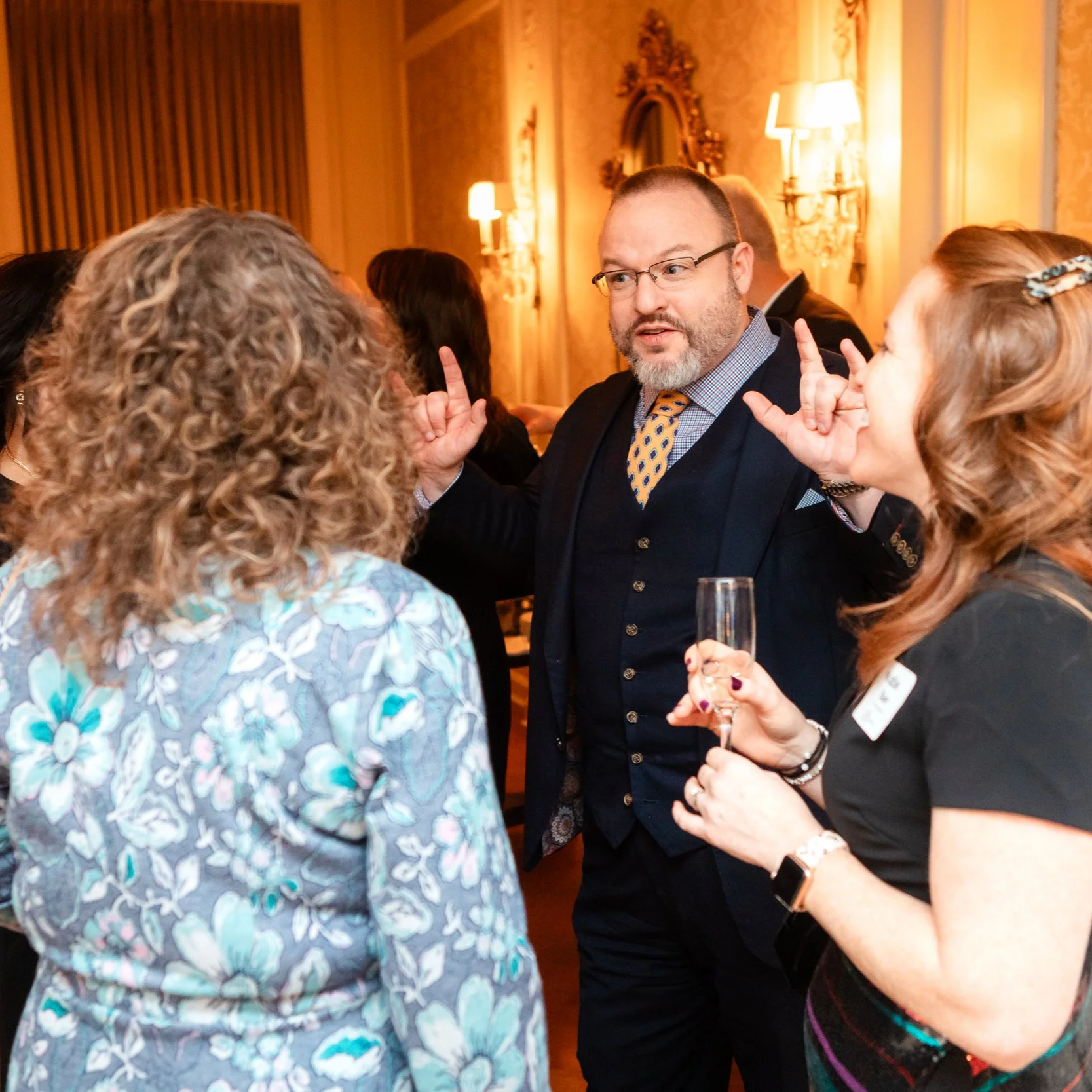
The Perecman Firm, New York. A holiday-season lunch for a New York personal-injury firm in the upstairs private room at Redeye Grill in Midtown Manhattan, December 2024, for about 40 guests.
Bayard Law, Wilmington. A cocktail hour at the Hotel DuPont in January 2025, for about 50 guests in cocktail attire. A post-holiday celebration.
Association of Corporate Counsel, Greater Philadelphia chapter. An evening event at One North Broad in Philadelphia in November 2024, for about 125 in-house lawyers. A room made up entirely of attorneys, the people who hire and manage outside counsel.
His wider corporate holiday work includes a holiday reception for a New York investment firm at The Standard, High Line, in December 2024.
Two formats that fit most firm parties
Walk-around during the cocktail hour or lunch. Gentry works the room in small groups, a few minutes at a time, and moves on. Guests who want to be involved step in, and the conversation carries on around it. Walk-around is priced by the hour and fits a private dining room as well as a ballroom.
A stand-up show after dinner. A set of 45 to 60 minutes that the whole firm shares. It plays to rooms as small as five and as large as several thousand, so it scales from a partners' dinner to a firm-wide celebration.
The two combine well: walk-around while people arrive and mix, then a short show once everyone is seated. A full technical rider ships with every contract, and the requirements are flexible enough for a restaurant room.
His fee is all-inclusive. He does not ordinarily bill separately for travel, so a firm in New York, Wilmington or anywhere else pays the same way as one in Philadelphia. Market-specific details are on the Philadelphia, New York and Delaware pages, and the full range of corporate and private work is on hire a mentalist magician for corporate and private events.
When to book law firm holiday party entertainment
October through December fills first. If you have a December date, ask about it as soon as the venue is confirmed.
There is no minimum lead time. If your plans firm up late, or another act falls through, ask anyway; he can often step in at short notice.
Frequently asked questions
What is good entertainment for a law firm holiday party?
Entertainment that works in mixed company, lets guests choose how involved they get and gives a skeptical audience something to think about. Strolling entertainment at the cocktail hour, a short after-dinner show, live music and a charitable component all work well. A corporate magician who specializes in mentalism covers the first two in one booking.
How do you keep a law firm holiday party professional?
Choose entertainment that is opt-in, team-based or watched as a group, and avoid anything that puts a single person on the spot in front of senior partners or clients. Serve plenty of food, schedule the entertainment to give the evening a shape, and set a clear end time.
Is a magician appropriate for a law firm event?
Yes, when the performer works corporate rooms. A corporate magician whose specialty is mentalism performs conversational, close-range mind reading written for adults and professional rooms. The legal audiences Gentry has performed for include a New York firm's holiday lunch, a Wilmington firm's cocktail hour and the Greater Philadelphia chapter of the Association of Corporate Counsel.
What are good law firm client appreciation event ideas?
A hosted reception or private dinner with entertainment that makes the guests the center of the moment. Walk-around mentalism suits client events because it moves from group to group, gives clients a story to take back to their own offices, and leaves the conversation between firm and client intact.
How long should entertainment run at a firm holiday party?
Walk-around work usually runs through the cocktail hour or a lunch, priced by the hour. A stand-up mentalism set runs 45 to 60 minutes. Combined, they cover the arrival and the centerpiece of the evening without taking it over.
How far ahead should we book for a December party?
As early as you can. October through December fills first, and prime December evenings go early. There is no minimum lead time, though, so a late inquiry is still worth sending.
Check availability for your firm's party
Send your date, venue and approximate guest count, and Gentry will tell you what fits: walk-around, a stand-up show, or both.