
New York Magician and Mentalist for Hire
Ninety minutes from Moynihan, in your Midtown room for the reception window.
Check availability for your New York date → Send the date, the venue and the headcount, and you get a straight answer on format and availability.
Gentry is a mentalist engaged regularly into New York, based in Philadelphia, ninety minutes down the Northeast Corridor. A train, a walk from Moynihan, and he is in your room — on a schedule that holds.
A mentalist interprets behavior to predict decisions. In New York that gets put to work in three quite different kinds of room: the exhibit floor, the corporate reception, and the private apartment.
Most acts fill a slot. This one shapes what the room does next.
New York engagements, under contract and by direct booking
ONUG 2025 — The Penn District, Manhattan. October 22, noon to six. Client: Lightyear. Booth #52. Trade show booth activation for lead generation in front of a telecom and enterprise networking audience — six hours on the floor, working in short repeated engagements, badge-reading before engaging, and walking each qualified prospect to a named rep. Athena Ascione, Lightyear's Senior Events and Marketing Leader, booked it and is one of the twelve reviewers on the testimonials page.
Smeg — Midtown Manhattan, May 2022. A corporate reception for the Italian kitchen appliance brand, near the Lincoln Tunnel, engaged directly by CEO Vittorio Bertozzini. Walk-around format, a design-literate guest list, and a brand whose entire proposition is that details are noticed.
Private residence, 1155 Park Avenue, Manhattan — January 2022.
Private residence, Brooklyn — June 2022.
A private residence overlooking the High Line.
Trade show booth entertainment at Javits and the Penn District
Trade shows are where this work earns its keep, and the New York floor behaves differently from every other market.
The Javits Center runs the largest shows on the East Coast, and the Penn District has become a genuine second pole for technology and enterprise events. What separates New York from Las Vegas or Orlando is the attendee mix: New York shows tend to be shorter, denser, and far more local, which means a much higher proportion of the people walking your aisle are buyers who came in from an office that morning rather than badge-collectors working a week-long convention.
That compresses everything. You have hours, not days. Badge qualification has to happen fast, the handoff to your rep has to be immediate, and anything that slows the aisle down is costing you the day. At ONUG the entire window was six hours.
How the format works in practice: a pre-show briefing on your target titles, your messaging and who is staffing the booth; short repeated engagements that stop people in the aisle without blocking it; qualification inside the conversation rather than at a scanner; and a warm handoff to a named person on your team, at a pace your booth throughput can actually absorb. Exhibitor rules — sound limits, aisle-line policy, union requirements, badge and check-in procedure — get asked for in advance rather than discovered on the morning. Detail at trade show presentations.
Hire a corporate mentalist in New York
New York is not one market. It is four or five markets that happen to share a subway system, and entertainment that works in one of them lands badly in another.
Midtown hotel ballrooms and conference receptions. Association meetings, financial services offsites, law firm client events, industry councils — ballrooms and function rooms roughly between 42nd and 59th, running on a schedule that does not flex. Cocktail hour is six to seven because dinner service is at seven because the room turns at ten. Anything that needs a soundcheck, a stage set or a fifteen-minute room reset is a liability in that structure. Walk-around mentalism arrives, works the room, and leaves the run of show exactly as printed.
The Midtown guest. Finance, law, consulting, media. Skeptical by profession and socially fluent — an audience that gives its attention on merit rather than on cue, and that responds to being offered a reason to lean in. Participation is an invitation, the room shares the experience, and the guest who steps forward comes out of it looking sharp in front of the client they came with.
Association meetings and awards nights. New York has an unusual concentration of trade associations, professional bodies and industry councils, and their annual meetings and awards nights are a category of their own: dinner-based, heavily networked, and built so the entertainment serves the networking rather than interrupting it. Reception walk-around is almost always the right call, with a post-dinner stand-up set when the awards portion is kept tight.
Private entertaining in Manhattan and Brooklyn. A distinct discipline. Twenty to fifty guests in an apartment, no stage, low ceilings, hard surfaces, and a host who wants the evening to feel effortless. Close-quarters mentalism is the right tool because it needs nothing built and works at conversational volume — Park Avenue apartments, Brooklyn brownstones, downtown lofts. The brief is always the same: give the guests something to talk about with each other, and leave the living room a living room.
Brooklyn and the outer boroughs. Brooklyn corporate and private entertaining has its own tone — less formal, more design-forward, often warehouse conversions and event lofts. The format flexes to it.
The logistics nobody puts in the brief. Load-in windows in Midtown are tight. Freight elevators in prewar buildings are booked weeks out. Union rules apply at Javits and at many hotels. Street closures, motorcades and marathon weekends can turn a fifteen-minute crosstown trip into an hour. Gentry arrives early by default and works formats that need no load-in, which takes that whole category of risk off your run of show.
New York venues and event spaces this work suits
Midtown hotel ballrooms and function rooms — receptions, association dinners and awards nights.
The Javits Center — booth activation on the largest exhibit floors on the East Coast.
The Penn District — technology and enterprise shows at ONUG scale.
Private clubs and closed event spaces across Manhattan, for corporate dinners that are not open to the building.
Downtown and Financial District venues — client entertaining and firm events.
Brooklyn event lofts and warehouse spaces — the less formal half of the corporate calendar.
Private apartments, brownstones and lofts — close-quarters entertaining.
Restaurant private dining rooms — the most common New York corporate dinner format, and one of the best fits for walk-around there is.
Named as rooms this work suits.
New York corporate entertainment formats
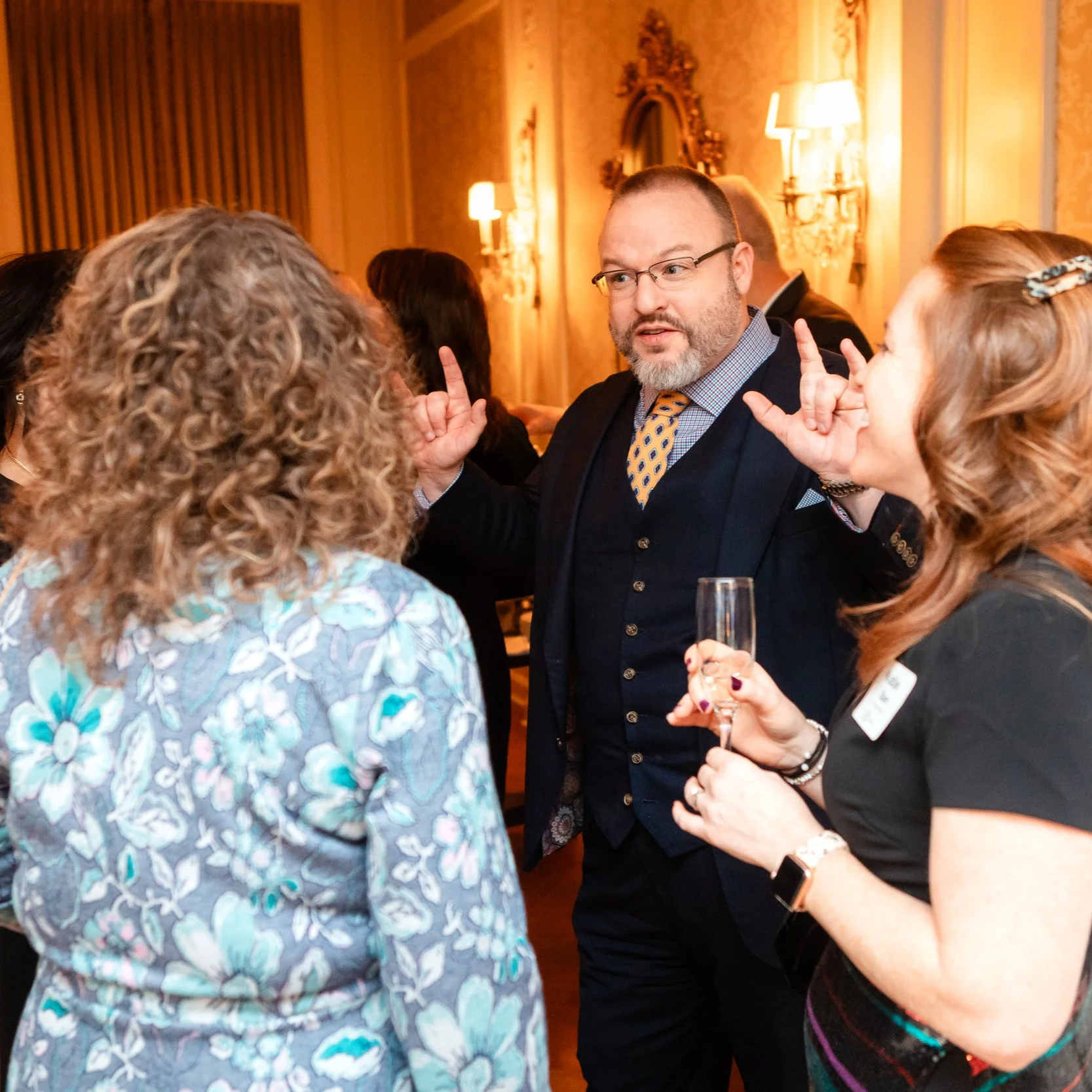
Walk-around mentalism for a New York reception or cocktail hour
Close-up mentalism moving group to group, three to a dozen people at a time. Cocktail hours, receptions, pre-service at a dinner, gallery-style events. The default New York format, because it asks nothing of the venue and nothing of the schedule.
Trade show booth activation
Half-day or full-day blocks on the exhibit floor, with pre-show briefing, badge qualification inside the conversation, and warm handoff by name. Built for Javits and Penn District floor dynamics.
Stand-up mentalism show for a New York corporate event
A structured performance with a handheld microphone and light on the performance area, for a seated or standing audience. It has played to rooms as small as five and as large as several thousand. Post-dinner, awards nights, association general sessions, firm retreats.
Walk-around plus stand-up: the full evening
Walk-around during the reception, stand-up after the meal. The strongest structure for a full corporate evening — it warms the room before it asks the room to sit down.
Magician for private events in Manhattan and Brooklyn
Close-up mentalism in apartments, brownstones and lofts. No equipment, no setup, no rearranging of a room the host has already made beautiful.
Keynote speaker on persuasion
A speaking program on rhetoric, persuasion and how belief gets built, delivered by someone with an MA in Rhetoric who taught it at university level, and demonstrated live rather than described. Built for sales kickoffs, leadership meetings and association general sessions. See keynotes.
Why New York planners hire Gentry
Gentry holds an MA in Rhetoric from Carnegie Mellon University and a BA in Philosophy. Rhetoric is the formal, two-thousand-year-old discipline of how people are persuaded — the study of argument, audience and proof. In a city whose professional class negotiates, pitches and prices risk for a living, a performer whose material is constructed the way an argument is constructed is speaking the local language.
He has taught at Carnegie Mellon, Temple University, Duquesne University and the University of Pittsburgh. His TEDx talk is Faking It IS Making It. Peace Corps, Ghana. JET Programme, Japan — years of holding a room's attention across a language barrier. Working jazz bassist, which is where the timing comes from.
Performances in dozens of countries, which is where a performer learns to hold a stranger who had every intention of walking past. That is useful in a Javits aisle, and equally useful at a Midtown cocktail hour where nobody asked to be entertained.
He is a mentalist, and he says so plainly. The work is performance — built on rhetoric, close observation and a career spent reading rooms — and in front of an audience that evaluates claims for a living, that plainness is exactly what earns their attention.
Client reviews
Reviewers with a direct line to the New York work:
Athena Ascione, Senior Events and Marketing Leader, Lightyear Telecom — booked the ONUG booth at the Penn District
Edan Tal, Director of Marketing, Port AI
Jackie Reardon, Head of Marketing, Sygnia Cybersecurity
Donna Thomas, CMP, Director of Events, Crowne Plaza Hotel
Devon Pasha, CMP, CED, Chief Experience Officer, DMP Creative
Michael Yoder, Booking Agent, Funny Business Entertainment Agency
All twelve, with full quotes: client reviews.
FAQ: hiring a mentalist in New York
How do I hire a mentalist for a corporate event in New York?
Send the room, the guest count, the schedule and what the event is supposed to accomplish, and a proposal comes back with a format recommendation and a quote. Gentry works New York regularly — ONUG at the Penn District, Smeg in Midtown, private residences on Park Avenue and in Brooklyn — from a base ninety minutes away on the Northeast Corridor. Start at contact.
Can he work a trade show booth at Javits or the Penn District?
Yes, and booth activation is a core format rather than a sideline. ONUG 2025 at the Penn District was a six-hour booth day for Lightyear in front of a telecom audience. He works inside exhibitor rules — sound limits, aisle-line policy, union requirements, badge and check-in procedure — and asks for them in advance.
What determines the fee for a New York booking?
The date, the format, the length of coverage and how many programs the day includes — walk-around, stand-up show, booth activation, keynote, or a combination. December corporate season carries its own demand, as does the spring association calendar. Every proposal comes back itemized.
When does he arrive?
Early, always. For anything with a hard call time — a booth open, a ceremony, a keynote slot — he arrives with real margin, and for an early-morning show open he comes in the night before. Midtown load-in windows and crosstown traffic get planned around rather than discovered.
What does he need from the venue?
Walk-around and booth activation run on open floor: he arrives and starts. A stand-up show typically wants a handheld microphone through house sound, a small table and light on the performance area, though the requirements are flexible and rooms rarely match a diagram. Nothing needs a load-in, which is worth real money in Midtown. A full technical rider ships with every contract.
Is this a good fit for a client-facing audience?
Yes — client entertaining is the heart of the New York work. Participation is by invitation, the room shares the experience together, and every guest who steps forward comes out of it looking sharp in front of the colleagues and clients whose good opinion they came to protect.
How many guests does this work for?
Walk-around works group by group, so it fits any headcount across a reception window. The stand-up show has played to rooms as small as five and as large as several thousand. Apartment work is usually somewhere between fifteen and sixty guests.
Can he perform in a private Manhattan or Brooklyn apartment?
Yes — private residence work is a documented and regular part of the New York calendar, including Manhattan apartments, Brooklyn residences, and a private residence overlooking the High Line. Apartment work needs no equipment and no setup.
How far in advance should we book a New York date?
December corporate season and the spring association calendar fill first, and trade show dates are worth holding as soon as you have your booth. Private dates carry more flexibility. Short notice is always worth asking about — a planner whose entertainment has just fallen through is exactly the call worth making.
Do you also cover the rest of the corridor?
Yes. The same train runs the other way — Philadelphia, Baltimore, Washington DC, Maryland and Virginia all have their own pages.
Book a New York date
Send the room, the guest count, the schedule, and what the event is supposed to accomplish. You will get a straight answer on format and the version of the program that does the most for it.